Don’t Flush That: No Wipes in Pipes!
 June 30, 2026
The straight poop about wipes, and why none are flushable (no matter what it says on the packaging)
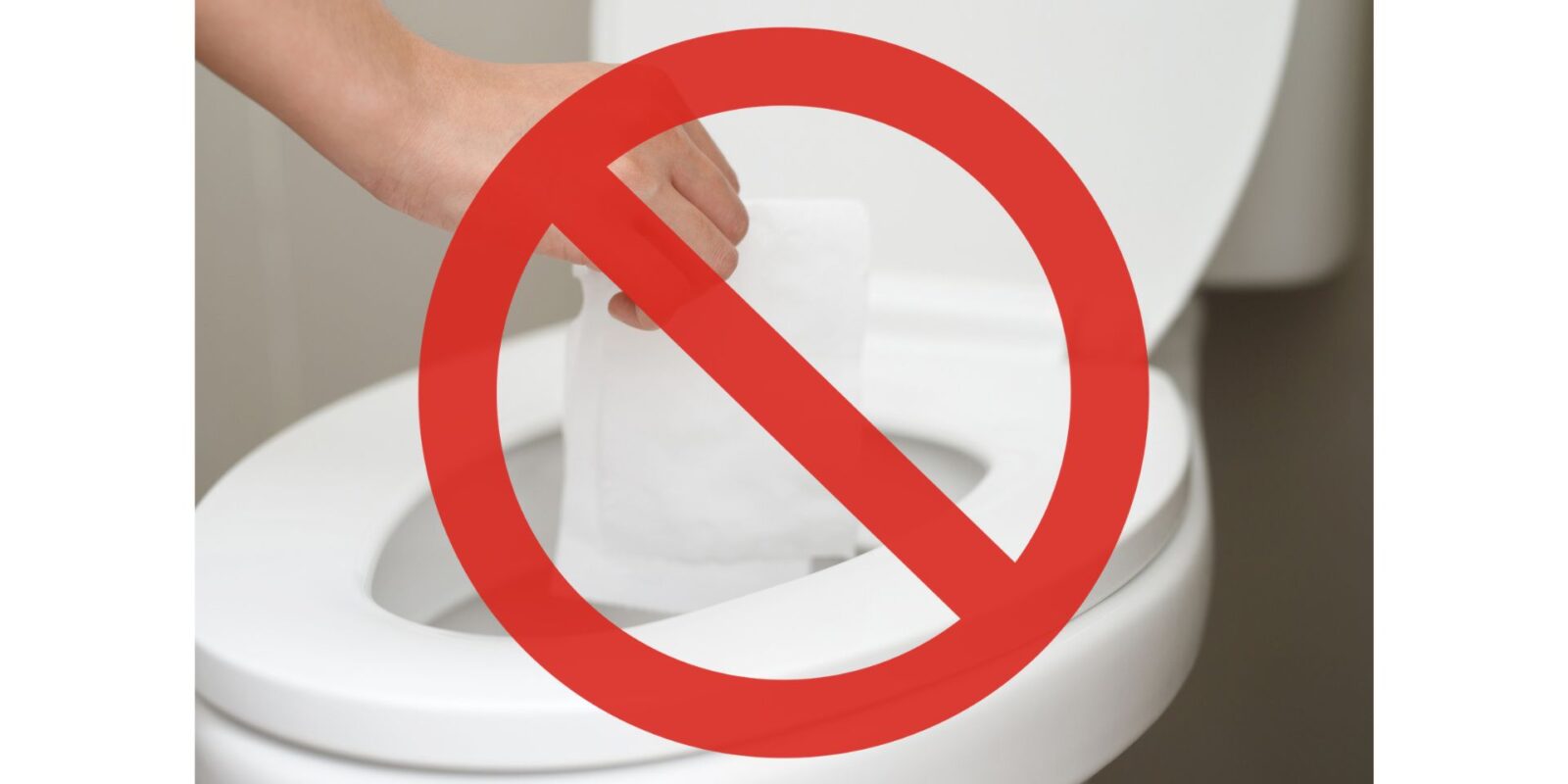
Let’s get something straight right now: Wipes are not safe for pipes.
It doesn’t matter if they are labeled flushable, disposable, toilet-safe or septic-safe.
They all belong in the trash.
No matter what else you learn from this article, that’s the main takeaway:
Wipes belong in the trash, not the toilet.

The only things that belong in a toilet are human waste and toilet paper.
Toilet Paper vs. Wipes: What’s the Difference?
So why is toilet paper flushable, and wipes are not?
Toilet paper is made from thin sheets of 100% paper. The short paper fibers dissolve almost as soon as they contact water.
TP is biodegradable and — most importantly here — easy to flush and easy on pipes, sewer systems and septic systems. It starts breaking down as soon as it hits the water in the toilet bowl. And while different thicknesses and plies dissolve at different rates, they all still break down pretty quickly under normal conditions and usage.
Wipes, on the other hand, are designed to hold moisture and stand up to vigorous use. They do NOT break down quickly. They rarely disintegrate; at least not for a very, very long time.
And that’s what causes problems when wipes are flushed.
Wipes Cause Costly Callouts

Plumbers frequently report that wipes are among the No.1 reason (along with FOG) they’re called out to fix clogs and messy sewer backups.
And ever since the global COVID pandemic in 2020, wipes, have become more common — and more problematic — than ever.
It’s the same story at LCA, and at other municipal wastewater systems all across the country — from Philadelphia and New York to Portland and San Diego and everywhere in between. In fact, wipes are causing problems all over the world.
Gotta Keep Grinding
Modern wastewater systems rely on different types of grinders at different stages to help break down waste and toilet paper into even smaller bits.
Some grinders are hooked in with residential lines; others are at various points in the wastewater system.
At our treatment plants, grinders and augers are essential to the treatment process — and they require constant monitoring and maintenance to deal with jams caused by wipes.


That’s because those long fibers, so useful for cleaning, are designed not to dissolve.
Instead of getting chopped up, like toilet paper and human waste, the fibers in wipes get wrapped around blades and auger shafts instead!
And that means someone needs to untangle disgusting messes like those in the accompanying photos, which were both taken at our treatment plants when clogged equipment had to be stopped and repaired.
The Long-Term Cost of Wipes
Dealing with clogs and jams and backups is not cheap — especially on an industrial scale. If you think the plumber’s bill to unclog your toilet was high, imagine what it costs to clear a sewer main or unjam a giant auger! One study found that wipes add $440 million a year in operating costs to U.S. wastewater utilities. And by necessity, that cost is increasingly getting passed on to customers.
But the long-term cost of wipes is likely even higher. If (and that’s a big if) wipes pass through household plumbing and sewer mains successfully, they become an ongoing problem within wastewater systems.
As we stated earlier, they get stuck in filters; jam up grinders, augers, and pumps. They also persist long after organic waste naturally decomposes.
That’s because wipes take years — in some cases, decades — to break down. Scientists have long warned about the synthetic fibers, microplastic pollution, and trash accumulation linked to wipes.
And that doesn’t even take into account the many issues arising from the one-time-use plastic packaging in which the wipes come wrapped.

A Wipes Alternative
If you simply cannot see yourself skipping bathroom wipes altogether, consider replacing them with a much more sustainable option: A bidet.
Compared with wipes and yes, even toilet paper, bidets are a far more environmentally friendly option.

Bidets work by aiming a gentle stream of water at your bottom. They’re the go-to cleaning method in bathrooms all over the world, but here in the U.S., they didn’t gain popularity until the TP shortages of COVID.
- They cut down considerably on toilet paper usage (just a square or two of TP is needed to dry).
- They eliminate any need for wipes.
- Because bidets clean using just water, they’re much easier on the wastewater infrastructure — no big lumps of TP or clumps of wipes to unclog.
- The amount of water bidets use, even over time, is minuscule compared with the amount of water used to produce a pack of toilet paper or a package of wipes.
For most bathrooms, a bidet seat similar to the one in the photo is the simplest option. It replaces the existing seat and, after a simple hookup to the toilet’s water line, adds a spray function.
There are multiple types of bidets and bidet seats, so do some research to figure out what type of bidet is best for your situation.
Types of Wipes
There are many different types of wipes (and just to reiterate, NONE should be flushed).
We’re going to cover four main groups:
Disinfecting Wipes
Disinfecting wipes are made for cleaning hands and surfaces, and killing harmful bacteria, viruses, or fungi. They’re made from woven or spun materials — including plastics — that prevent them from breaking easily apart.
These are absolutely, positively not flushable.
They easily tangle in equipment designed for breaking up and screening solid waste.
They easily cause stubborn, expensive clogs and jams on both the homeowner’s and LCA’s side.

And they last in the environment for a long, long time.
(Note: There are some eco-friendly options, like chemical free bamboo-based wipes that, while still not flushable, are compostable).
Baby Wipes/Cleansing wipes

Created specifically for delicate skin. Some are hypoallergenic, some are scented, some are designed to be eco-friendly … but none are flushable.
There are quite a variety of more specific wipes in this category — makeup removal wipes; cooling wipes for fevers; wipes branded for men; wipes branded for women; wipes for cleaning kid-related equipment and toys, and so many more. And like above, there are eco-friendly options.
None of these are flushable!
Surface Cleaning and Disinfecting Wipes
These were created for bathrooms, kitchens, clinics, and offices — places where germs love to party and hands are always in attendance.
Most of these wipes include bleach or alcohol-based ingredients for maximum germ- and grime-fighting effectiveness.
They are created with tougher fibers that do not break apart easily, and should never be flushed.

Flushable Wipes
Nope, sorry. They may say “flushable,” but “flushable” wipes still cause clogs and jams and should not be flushed. Wipes do not belong in pipes. Period.
“Flushable” wipes are advertised as breaking down in water like toilet paper does, but in practice, that does not happen.

Multiple companies have now lost lawsuits over deceptive messaging on wipes advertised as “flushable” — wipes that went on to cause extensive damage to septic and sewer systems. Other lawsuits target unsafe ingredients in products designed for children.
A recent bill, the WIPPES Act, is aiming to create a national policy for the labeling of ‘non-flushable’ wipes.
But in the meantime, wipes are still causing a lot of very expensive (and, ironically, messy) problems.
So here’s the straight poop about wipes: If you choose to use them, always throw them in the trash.
The only things that belong in the toilet are human waste and toilet paper.